
A place worth staying: The story of the first Mexicans
Gordon Hawkes is a world traveller with over 110 countries visited. Mexico is his favourite place in the world, a land he turns to whenever he is lost or confused with life, which means he visits regularly! He loves hiking in a desert wilderness or sitting in a dusty library with old books.
Historians dispute when humans first wandered onto the American continent. The long-accepted view of 15,000 to 20,000 years ago is increasingly being challenged by new archaeological discoveries that might push the date back to as early as 30,000 years ago. Whatever date we assign to human arrival in the American continent, we should visualize small bands of humans wandering some distance across this empty world, searching for an environment that would tempt them to stay for a while. Once they had exhausted the resources in one place, they would move on.
With the continent's long coastline providing a "highway," a small human population was able to spread across the continent with surprising speed. There is a suggestion, although the evidence from the Chiquihuite Cave is strongly disputed, that the first bands of humans may have reached Mexico around 30,000 years ago. What is not in doubt is that the hold these arrivals had on the country was provisional, and would remain so for a very long time
A new and more clearly defined chapter to the human story starts 10,000 years ago. At the time, there were just 1 to 4 million people in the entire world, of which only a few thousand would have been spread across Mexico. However, something remarkable was about to happen. Until this point, humans had taken all their needs directly from nature, but now they started to support themselves with a little gardening. This occurred more or less spontaneously in several different places around the globe, suggesting it was being driven by necessity.
Across the great Eurasian landmass, farming spread out from two central points. Across America, it began in several different places at once, with Mexico being one of the centers. Here, farming started with the cultivation of wild squash and the domestication of dogs, ducks, and turkeys. As people adapted to a sedentary existence beside their fields, it became worth investing in more permanent homes. The simple lean-tos that could be nonchalantly abandoned whenever the family moved on were replaced by huts with an intricate wooden frame. People not constantly moving could also gather a few possessions, and pottery became a common part of village life.
All across the globe, the bulk of food production depended on cultivating the wild grasses, primarily wheat in more northern regions of the planet and rice where the climate was wetter and hotter. Neither crop was found in the Americas. There was one American plant with the potential to become a "super crop," and it was this super crop that transformed the continent.
Right now, however, maize was still far from the finished item. The yellow-white seeds, while showing promise, were considerably smaller than the plant we recognize today, and would have been close to inedible unless cooked correctly. And, before maize becomes truly useful, the seeds have to be crushed into flour, mixed with water, and baked into some form of bread. Until the technology of grindstones and ovens became widely available, maize was just one of several crops that were supplementing rather than replacing what could be gathered directly from the wild.
Even limited farming brought an increase in the population, and a few of the small villages scattered across Mexico started to expand into larger communities. Around 3,500 years ago, people living in the village of Paso de la Amada, on the Pacific coast of Chiapas, constructed a ball court, where men competed in a prototype of the game the Spaniards would witness when they finally reached these shores. Deep in the Oaxaca Valley, one village grew into a regional center, where the population labored on a communal building known as the "men's house." Humans had already found their way up to the high plateau where Mexico City now stands, and here too the nomadic lifestyle gave way to farming. The climate at 2,000 meters was cold, and many areas lacked adequate water, but humans were drawn toward one central valley, a hundred kilometers long, sixty kilometers wide, that was blessed with lakes and marshes. Where there is water, there will be deer, birds, and edible plants, and where there is water and good volcanic soil, people can overcome almost any other problem and grow crops.
They also occupied the narrow bands of forests and tropical savanna that lay between the plateau and coast, and here too they were able to shape the land to their needs. Tools were primitive, with much of the agricultural work being undertaken with a simple, sharpened and fire-hardened stick. Known as a coa, this was used to punch holes into the ground, allowing seeds to be dropped, one by one, into the damp lower soil. It was hard, slow work, most successfully undertaken in lower river valleys, where regular floods softened and rejuvenated the soil. Yet the land along the coast was blessed by a climate that was hot and humid, and labor was rewarded with crops of squash, beans, manioc, sweet potatoes, tomatoes, and a little maize.
As villages grew larger and produced a small surplus of food, it encouraged traders to move between them. As everything had to be carried on their backs, the first traders tended to deal in small, high-value items. If it was tin that drove trade across Eurasia, here in Central America it was obsidian. This volcanic glass came from the north and, in the absence of useful metals, could be shaped into tools and weapons. Some obsidian occurred in a dark green shade, a color that represented the fertility of the land and the importance of water. Green artifacts — beads, carved animal effigies, colored marine shells, magnetite, and the green feathers of the quetzal bird — were also desirable. Jade is a hard stone, and to carve it well required skillful craftsmen with specialist tools, including abrasives, saws, and drills. It was jade which helped to establish a brotherhood of talented artists.
The range of trade goods was probably far more varied than the surviving evidence indicates. A study of Central American river turtles shows their genetics to be surprisingly mixed. The suggestion is that, 3,000 years ago, live animals, captured in one river system, were traded with some distant village. Asphalt, invaluable as a means of waterproofing boats, was probably another important trade item that has left little trace in the archaeological record.
This was the world in which one community pulled decisively ahead of the rest. It grew up at the site we now call San Lorenzo in the state of Veracruz, and its people enjoyed one great advantage. Floods regularly turned the surrounding savanna into a shallow lake which watered and fertilized their fields and provided a seasonal harvest of fish and turtles. The community expanded until 5,000 people were living in the immediate vicinity. San Lorenzo was then the largest community on the American continent.
There was a downside to settling into villages of this size, for the immediate environment was stripped of firewood, and the wildlife was chased away. Although there was more food, there was less variety in the diet — maize was still not yet the crop that would one day feed cities — and life remained harsh. The villagers were physically small, their children likely to suffer from malnutrition.
San Lorenzo continued to overshadow any other American community, and by 3,000 years ago was producing a surplus of both agricultural produce and human muscle that could be channeled into ambitious artistic projects. Teams of laborers were dispatched to the Tuxtlas Mountains, some sixty kilometers to the northwest, where the slopes of Cerro Cintepec had shed boulders of dark volcanic basalt, a few of them already close to the shape of a human head. Such a boulder weighs eight tons, and the largest weigh forty. There were no draft animals here, and no wheels. The stone had to be levered and rolled down to navigable water, floated out on rafts and up the Coatzacoalcos River, and then hauled up the slope onto the plateau where the town stood — a journey of weeks, demanding hundreds of men, undertaken so that a single face could be carved at the end of it. Here artists worked the boulders into giant heads, with tight lips, flat noses, and mysterious headgear.
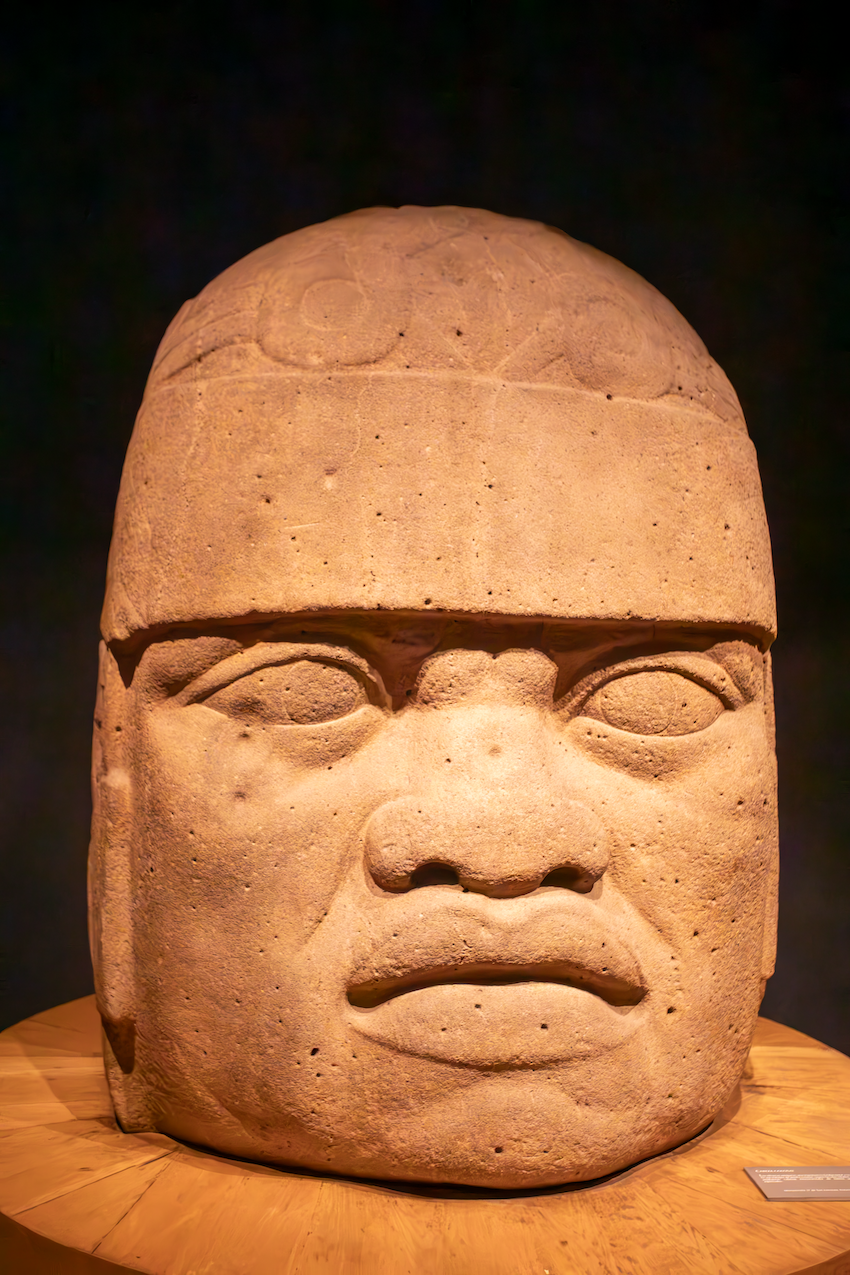
We can only guess whom these portraits represented, though the scale of them, and the individuality of the faces, points to rulers. The claim that their features are evidence of ancient sea links with Africa — first made in the nineteenth century, by the man who came across the earliest of the heads — has proved remarkably durable, but nothing supports it. The basalt is local. The style belongs to an unbroken Mexican tradition.
No African object or burial has been found at an Olmec site, and the faces fall within the range of features still common along this coast. A more legitimate debate centers on whether the "helmets" had a military purpose, and are therefore evidence that, despite an apparent lack of weapons, this was an aggressive society. Alternatively, they might have been ceremonial, or even protection for players taking part in the ritual ball games. What is undisputed is that work on this scale must have been planned and directed, perhaps by a priestly elite.
Yet, the human grip on the land was flimsy. There were only around a thousand people at Paso de la Amada, while the entire Oaxaca Valley, 40 kilometers from northwest to southeast, supported a population of perhaps two thousand. Even San Lorenzo was only a small town, while the rest of the country was occupied by little more than scattered villages. Even this fragile conquest of nature was about to be tested, for around 3,000 years ago there was a continent-wide disaster. In the north of the continent, drought killed off tracts of forest and allowed the prairies to expand westward. Far to the south, the people on the Peruvian coast surrendered parched fields back to nature, while the water level of Lake Titicaca dropped so low that the southern shore of the lake had to be abandoned.
Mexico was not spared, and the community at San Lorenzo declined. It is tempting to lay this at the door of the weather. But was it the climate that emptied San Lorenzo?
Disasters of this magnitude seldom result from a single action, and shifting river tributaries, the destructive habits of farmers, volcanic activity, and human violence are all suspects. But a changing climate was among them, and for a time the world turned against these people.
Yet humans are hardy and adaptable creatures, and Mexico's early inhabitants would recover and prosper. The heads outlasted the town that made them. And the cold valley on the high plateau, where a few thousand farmers had gathered around the lakes, would in time hold Tenochtitlan — a city of perhaps two hundred thousand people, and the last of these communities to be taken by surprise.