
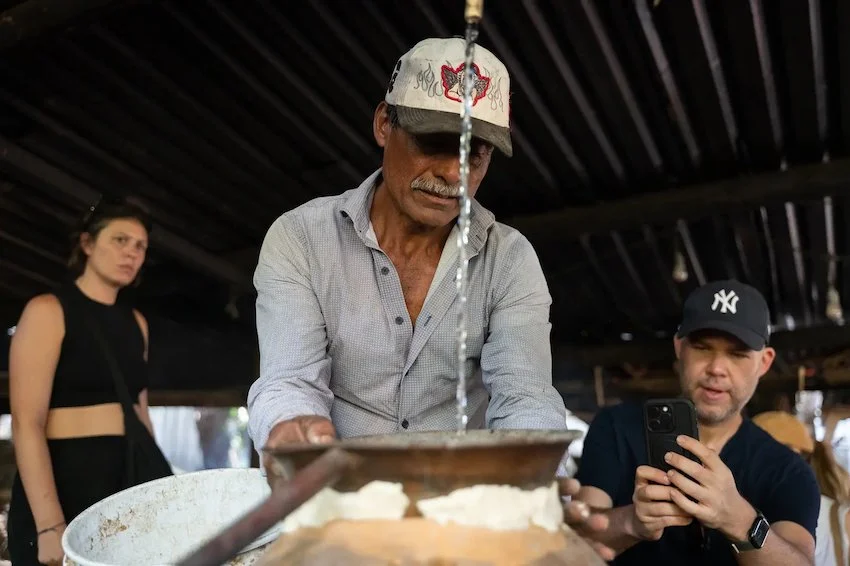
Fruit for the Still, Mezcal for the Dead
In Zapotec tradition, mezcal is a way of reaching the spirits, and across Oaxaca the first sip is still often poured on the ground for the earth and for the ancestors. Curanderos, the traditional healers, rub mezcal into the skin of the sick or spray it over them from their mouths.
It is poured at weddings, at funerals and at the fiestas for a village’s patron saint. People here have a saying for it: para todo mal, mezcal, y para todo bien, también. For everything bad, mezcal, and for everything good, too.
The reverence is older than the drink. The word mezcal comes from the Nahuatl mexcalli, or cooked agave, and the plant was sacred long before anyone distilled it.
In one Nahua legend from central Mexico, the first agave grew from the buried bones of Mayahuel, a goddess killed for running away with Quetzalcoatl. Seen that way, the drops we had poured into the soil were simply returning a little of the plant to the ground it came from.
Pauses like the blessing are part of making mezcal, and none of its stages can be rushed. The plant has to reach full maturity: seven years or more for a cultivated espadín, and far longer for many wild agaves.
The oven has to be built with care. The roasted agave is crushed and left to ferment slowly in wooden vats with ambient yeasts, and the distillation needs close watching. The reward for all that patience is a rich, complex spirit.
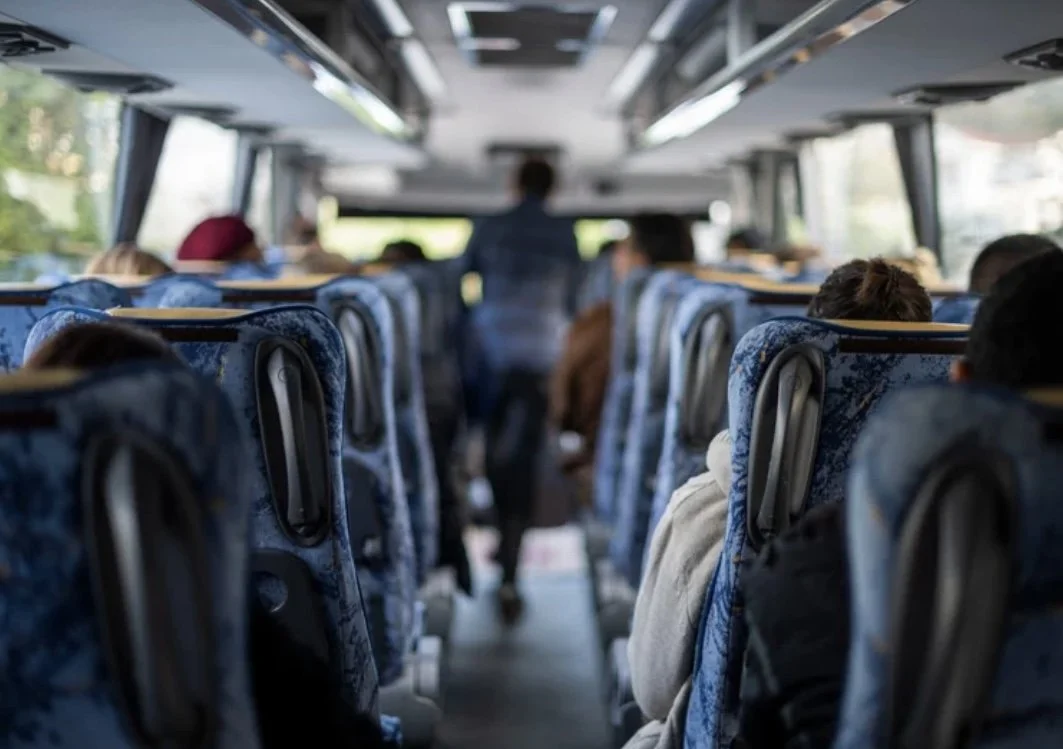
Somewhere between Chicago and Durango
It was always an occasion. Almost a ritual; a ceremony.
My dad, my brother, and sometimes an uncle would load up our eight-passenger SUV and hitch a trailer behind it to hold the luggage of seven travelers. I never helped. I mostly watched with excited anticipation as they packed and repacked, strapped things down, and made sure everything was secure enough to survive three days on the road from the Chicago suburbs all the way to our village in Durango.
Sometimes, the preparations themselves stretched over a couple of days.
Once on the road, the U.S. was insultingly flat and unending. For hours, especially through Illinois and Oklahoma, the view from my window seemed determined to look exactly the same. Finally, somewhere in Texas, the landscape began to shift. The terrain grew drier and more dramatic.
I could feel Mexico getting closer.
I don’t particularly enjoy driving in my daily life, but I love watching the scenery change. I relish the liminal state of doing nothing while witnessing one world become another.
Decades later, after buses through Southeast Asia, trains through Europe, and countless flights around the world, some of my most enduring travel memories still belong to those three-day drives to Durango.
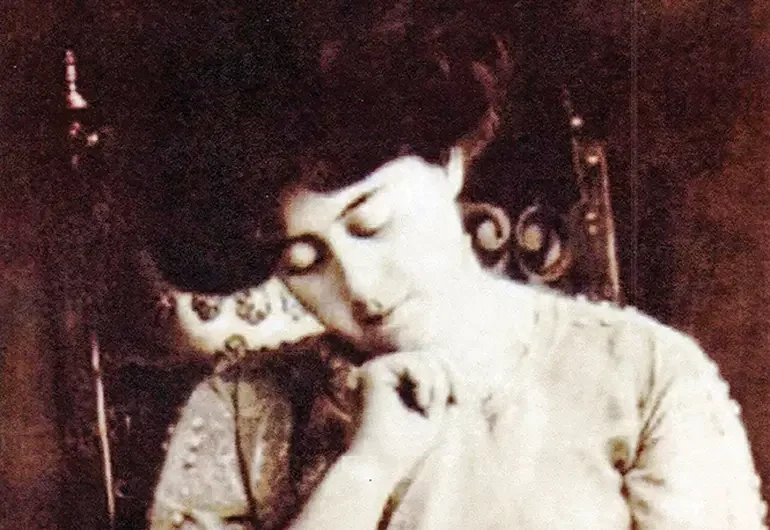
She didn’t have an army; she had a better idea
I’ve always found something peculiar about the way we remember history. Presidents get their portraits, generals get their statues, and the people who win revolutions tend to get their grand celebrations. We learn about battles, treaties, political upheaval, and the people who changed the direction of a country. What we don’t always hear about, though, are the people who saw something desperately wrong and decided to do something about it themselves.
Sometimes their contribution is enormous. Sometimes it saves lives. Sometimes it changes a country’s direction. And sometimes, despite everything, they’re almost completely forgotten.
Elena Arizmendi Mejía was one of those people.
In 1911, while Mexico was in the middle of a revolution, Elena did something that seems almost ridiculously straightforward when you describe it today. She organised medical assistance for wounded people who weren’t receiving it because of which side they happened to be fighting on. It was a simple idea, really. If someone was bleeding, you put politics aside, and you helped them.
It was also an idea that would put her at the centre of a rather extraordinary chapter in Mexican history.
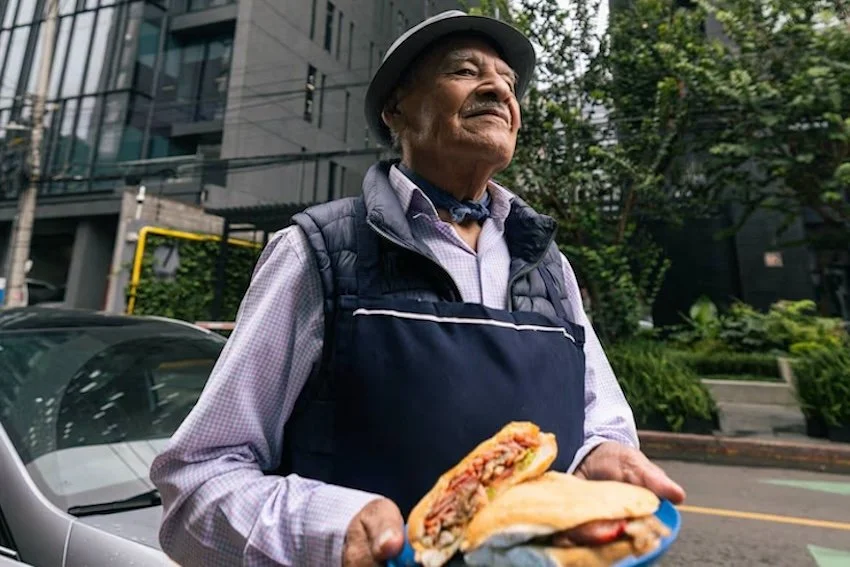
In the news: Tortas yes, displacement no
Don Pepe arrived in Mexico City in 1959, aged just 19, having grown up near the Nevado de Toluca. He settled in the Granada area and began making tortas on the very day he arrived. After 27 years working with relatives in the business, where they could produce more than 2,000 tortas a day, he eventually decided to set up on his own. By the late 1980s, he’d rented a space and started building a business with his family.
It wasn’t always easy. He recalled the debts he accumulated in those early years and the guilt he felt when some of his children left school to help keep the business going. But it was something they’d built together, and over time, it became part of the neighbourhood itself.
Granada, though, was changing. Around 2000, local authorities relocated the business to a new position, and what followed was years of uncertainty over its location and paperwork. Further construction, disputes over the space, the seizure of the family’s stand, and the pandemic all took their toll.
In 2024, the family was given permission to return to the area, although not to its original location. They set up again near Parque Lineal Ferrocarril de Cuernavaca.
Four days later, the stand was stolen.
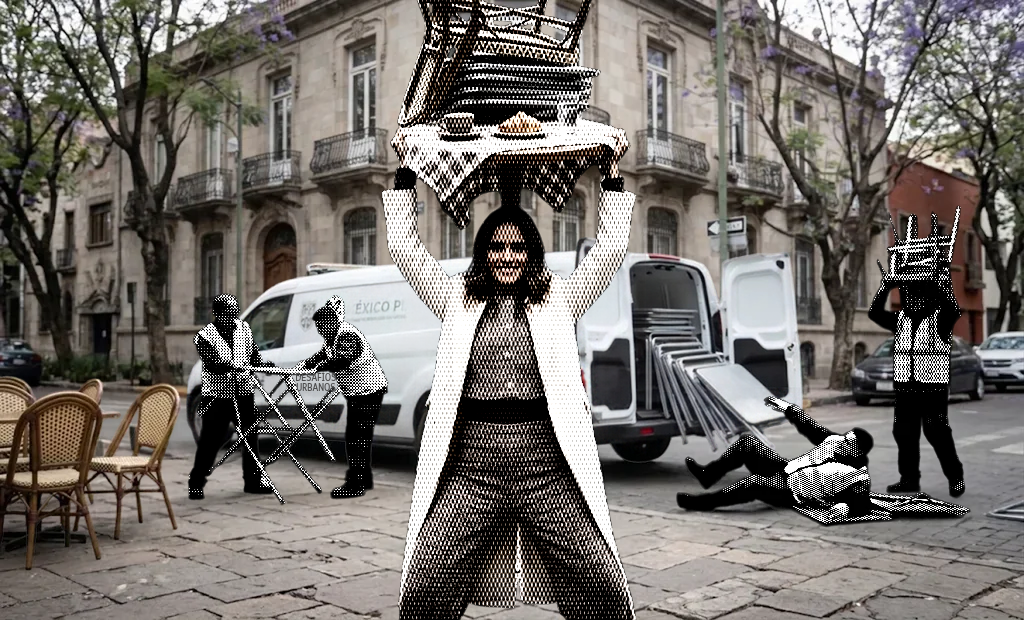
Mexico City’s most online mayor is coming for your café patio
“The alcaldesa took everything last night,” a waiter told me.
Everything is a slight exaggeration. Where nine tables once stood, four remain (please don’t fact check me on those exact numbers) and where a lovely collection of potted plants lined the facade, zero survived the vespertine visit.
Alcaldesa (mayor) Alessandra Rojo de la Vega is quite the star. She’s hot, she’s loud, she’s social-media-savvy. And she’s determined to take down Morena (or, at minimum, remain the party’s key opposition leader). She’s a pioneer of gender safety, building a network of 400 “Puntos Violeta,” safe spaces where women at risk can wait for help from the borough’s police (she even signed an agreement to put 186 of them inside local restaurants – ironic, given what follows).
Here, women can start the process of reporting violence with support from a team of lawyers and psychologists on call 24/7. (Alcaldía Cuauhtémoc) She’s overseen the rehabilitation of public parks and walkways, including a total revamp of Plaza Río de Janeiro. During the recent dog-poisoning scandal in Condesa’s Parque España, Rojo de la Vega raised the alarm by immediately hitting the streets, declaring “No son cifras, son vidas” (“They’re not numbers, they’re lives”) and urging witnesses to come forward. A couple of days later, she delivered security footage gathered from neighbors to the city prosecutor’s office, and on Friday, October 30, city police announced the suspect’s arrest.
Still, she’s not everyone’s cup of tea, and her latest restaurant raid serves as clear evidence.
There’s always someone who knows someone who knows someone
There are a few things you learn fairly quickly when you move to Mexico.
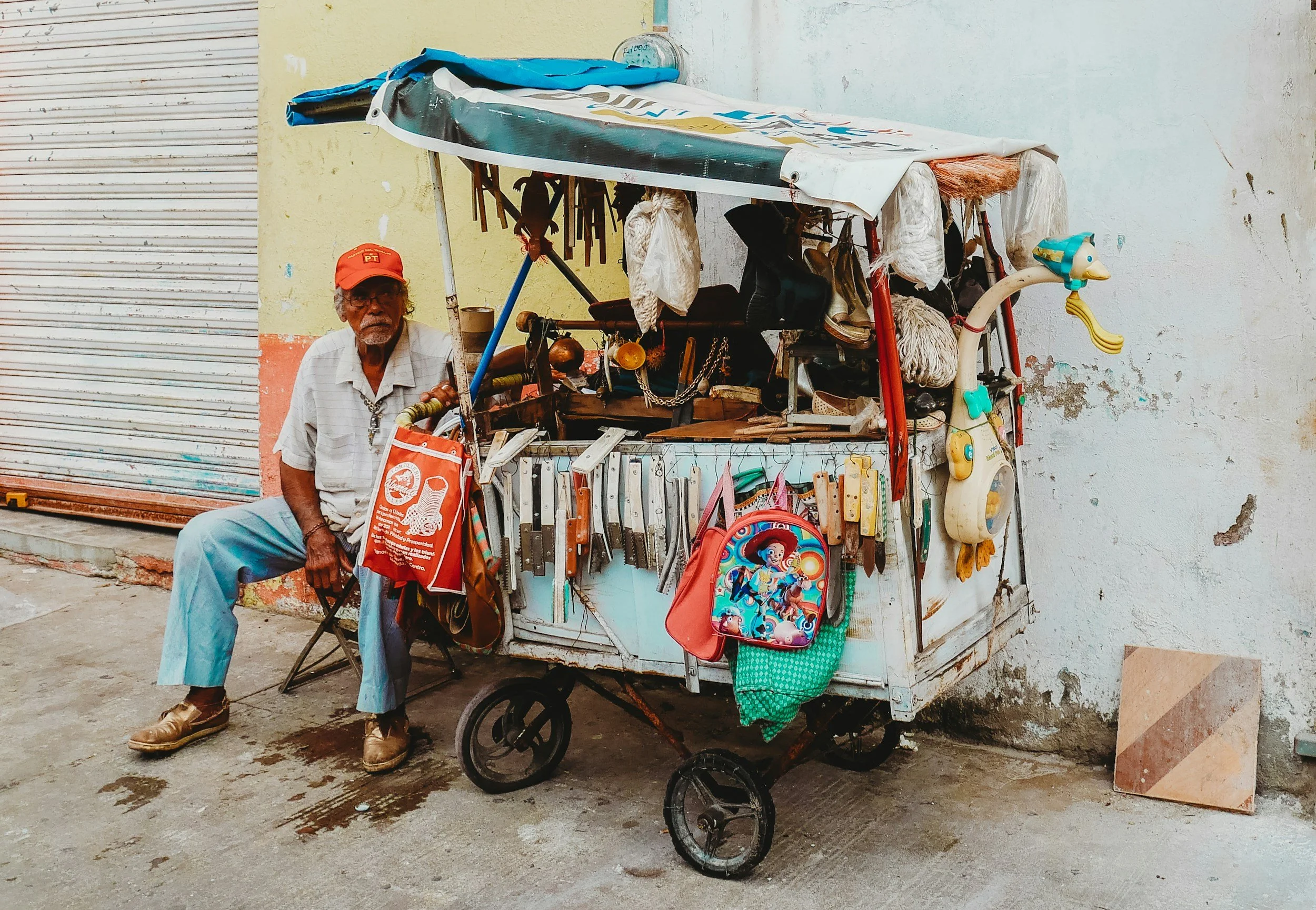
How to recognise the sound of the gas truck from three streets away, which tunes floating through the air are signals of the ice cream man and which are for the pan man, why you should never assume that a blue sky means it won’t rain, and that if you need something, anything at all, the first question you should ask isn’t necessarily where to buy it.
It’s whether someone knows someone who knows someone who knows someone who can get it.
I’m not entirely sure when I first noticed this particular Mexican phenomenon, but having lived here for six years, I’ve come to appreciate that there’s an entire unofficial economy operating alongside the shops, businesses, and services we’re all familiar with. It runs on relationships, recommendations, WhatsApp messages, and an extraordinary network of people who seem to know absolutely everyone who can do absolutely everything.
Need a plumber? Someone knows one. Need a new washing machine? Someone knows a guy who sells them. Looking for a particular building material that you can’t find anywhere? Don’t worry. Someone has a cousin whose neighbour’s nephew's girlfriend works at a place that most definitely has it.
Need a car part for a vehicle that hasn’t been manufactured in fifteen years? Well, that’s going to take a little longer, but someone knows someone. And the really impressive thing is that they don’t just know someone. They know someone who can get it cheaper.

In Mexico, there are no quiet fans
From kindergarten futbol fields to World Cup stadiums, Mexico has turned cheering into something of an art form. And not because of the athletes or the games themselves.
You see, I've learned a thing or two after years of attending sporting events in Mexico, and it's that nobody, and I mean nobody, comes to sit quietly. It doesn't matter whether you're watching a professional athlete compete in front of thousands or a group of six-year-olds chasing a ball around a field. The enthusiasm is remarkably similar. The volume is impressive. The language can be colourful. And the emotional investment? You would think someone's entire future depended on the outcome.
Coming from Canada, where spectators are generally expected to maintain at least some degree of composure, it was one of those cultural differences that initially caught me off guard. Here, the crowd isn't simply watching the game. It's actively participating, and sometimes, the spectators are every bit as entertaining as the athletes.
Let's just say officiating a sporting event here is probably not a career for the thin-skinned.
From Here: Beginning again, 30 years later
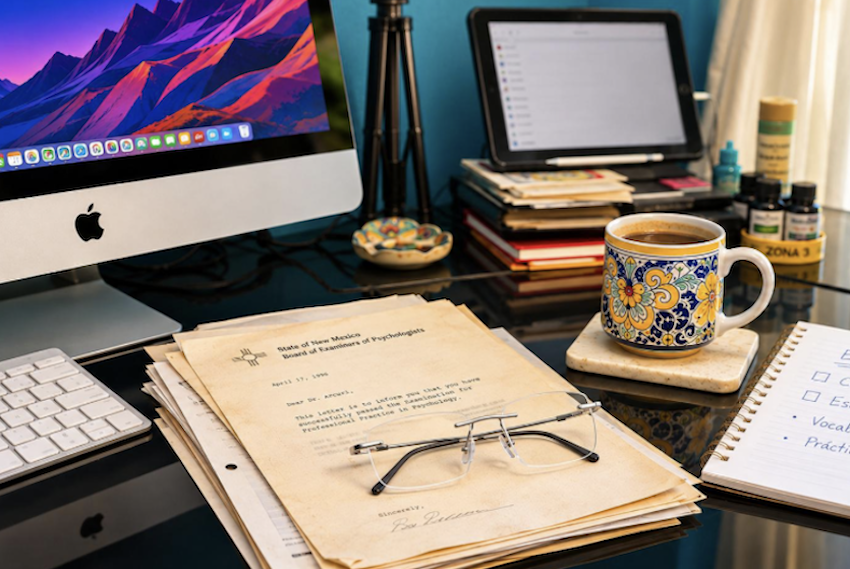
There is something curious about having to explain a period of one's life that has long since become part of an established history. I remember the education and training, the people involved, and the professional work that followed. The application requires a different kind of accounting. Dates, documented hours, evaluations, and original signatures have to establish what occurred, often for someone who had no connection to that period and must make a determination according to present-day standards.
The licensing specialist working with me in Texas has been remarkably attentive, asking questions that may help the Board understand my background and anticipate concerns before the application reaches a decision. I appreciate that approach, particularly because some of the original institutional records are no longer available. Our correspondence has involved reconstructing a professional history from documents that still exist and acknowledging the limitations of what can now be verified. The process has given me an unexpected opportunity to look again at the years when I was still becoming established in my field.
Dallas itself has a place in that history. Following completion of my doctorate in 2002, I spent a year at UT Southwestern Medical Center in a clinical psychology fellowship with the Consult Liaison Psychiatry and Behavioral Medicine service. It was an important period in my professional development, and I could hardly have imagined then that I would return more than two decades later for a fingerprinting appointment related to another licensing application. This time, I traveled from my home in México, where much of my work now takes place remotely and where my daily life has developed in directions I had never anticipated.

In the news: How does a 14-year-old become a cartel arms dealer?
In May 2023, a 15-year-old was arrested for bringing an AR-15, with ammo, to school. In August 2024, another high school student was arrested for bringing a handgun on campus. In May 2025, two students were caught with guns and bullets. We know the U.S. has a gun problem — but what’s happening in Arizona is different.
In early October, Paulina Villegas of the New York Times ran an investigative report on the Phoenix Boys, a syndicate of high school students buying guns in the U.S. and selling them to cartels, notably Sinaloa, who largely controls the arms pipeline between Arizona and Mexico. The boys’ ages dip as horrifying young as 14, their monthly bankrolls likely in the tens of thousands.
Of the network, four agreed to talk to Villegas under the strict condition of anonymity. She accompanied them from the Arizona desert to the state of Sinaloa, tracing the arms from north to south. Getting the weapons to Mexico, as Carlos A. Pérez Ricart reported for El País in 2024, “is child’s play”. In the case of the Phoenix boys, students simply drove the stash to the border,
Buying guns is where things get really interesting. If you don’t have a stash of cash to invest in your first firearm, how are you supposed to enter the game?
A heritage that’s out of tune
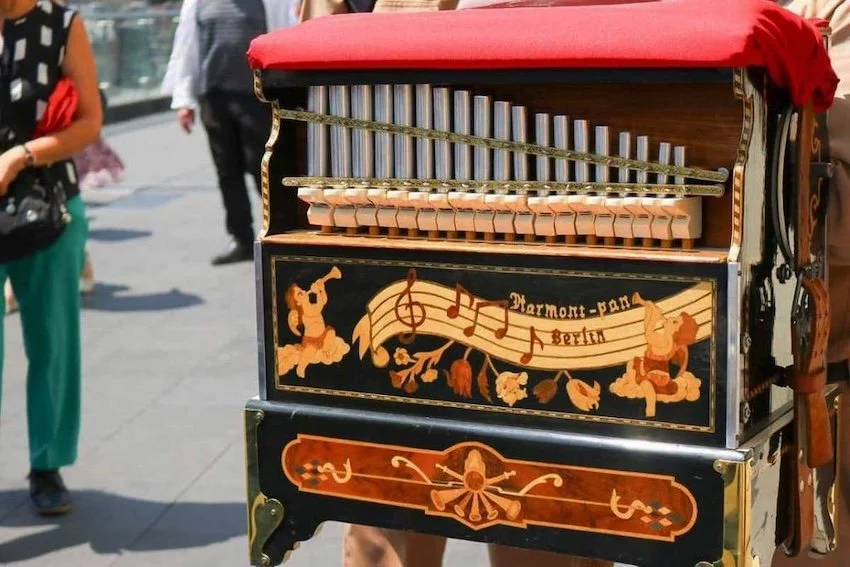
The writer Ricardo Cortés Tamayo once observed that nobody had ever told an organ grinder to take his music somewhere else. That was, at least, until April 2017, when a woman at the corner of República de Venezuela and Carmen, in Mexico City’s historic center, brought a vase down on a grinder’s head to make him stop. This unsurprisingly ended in a trip to the hospital, and then to the prosecutor’s office.
In January 2026, the city has sided with the grinder. A heritage commission voted unanimously to make the trade part of Mexico City’s intangible cultural heritage, and the capital promised to protect and promote it. A moving gesture, even if the machine at the heart of it is no longer made anywhere in the country.
The story of how Mexico’s organs got here depends on who is telling it.
Confessions of a Whitexican wedding crasher
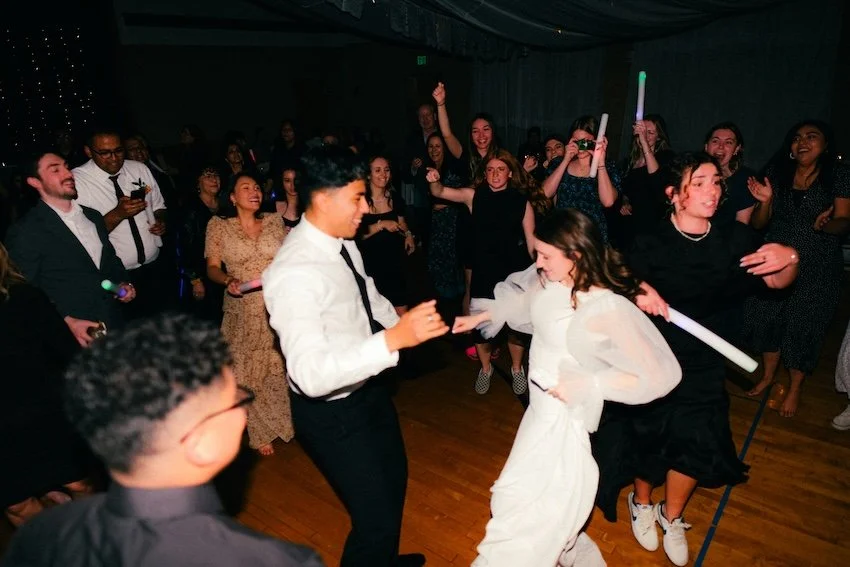
As the party unfolded, I began to feel like I was inside an episode of the wildly popular early-2000s telenovela Rebelde, which followed the lives of hyper-privileged Mexican teens attending an elite private school. The show offered a fictionalized glimpse into how Mexico's wealthiest young people lived and played.
Rebelde felt like a love letter to “fresa” culture, with a healthy dose of satire. Fresa describes preppy, affluent, privileged Mexicans. In recent years, the term has been joined by "whitexican," a more politically charged label highlighting the relationship between whiteness, wealth, privilege, and social disconnection.
The first time I felt like I'd rubbed shoulders with characters straight out of Rebelde was during my study-abroad semester in Florence, Italy, in 2011. My university partnered with an Italian school that also hosted students from private Mexican institutions. There, I met wealthy Mexican students who spoke fluent English, had traveled extensively, and received generous monthly allowances. Thankfully, unlike their fictional counterparts, my new friends weren't snobby or elitist. They were sweet, lovely people.
But their understanding of finances was comically different from ours.
Mexico has a song for every kind of heartbreak
There are few things quite as dramatic as a broken heart, and if you’ve spent any time listening to Mexican music, you’ll know that pretending everything is fine isn’t always the preferred response.
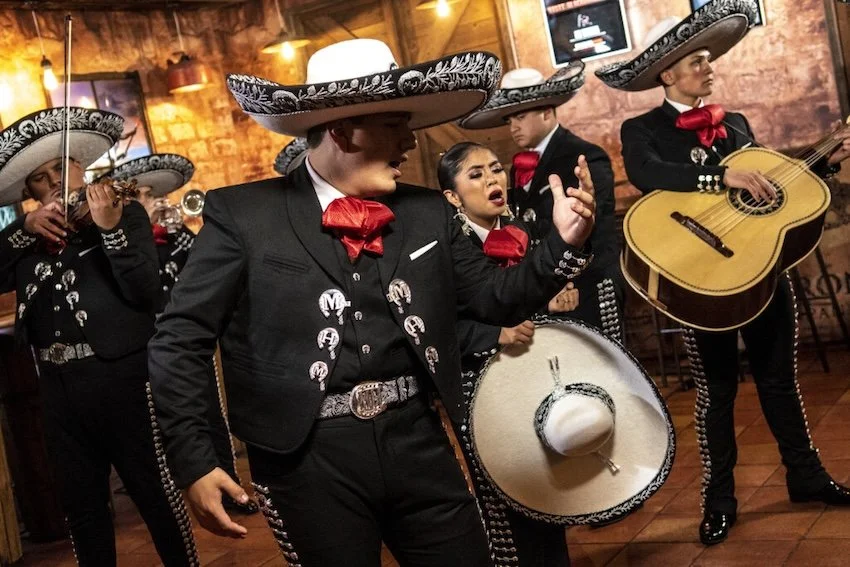
Sometimes heartbreak calls for a quiet drink and a little solitude. Other times, it calls for a mariachi band, a public declaration of undying love, a dramatically passionate exit, and enough emotional turmoil to keep the neighbours entertained for the rest of the evening.
I’m exaggerating, of course. Slightly.
But spend enough time in Mexico and you’ll discover that love and loss occupy a rather significant place in the country’s musical traditions, and that’s there’s a song for almost every stage of a romantic disaster.
The wonderful thing is that these songs don’t necessarily expect you to get over it. Sometimes, they simply let you feel it.
Morbid or moving? The bone cleaners of Campeche
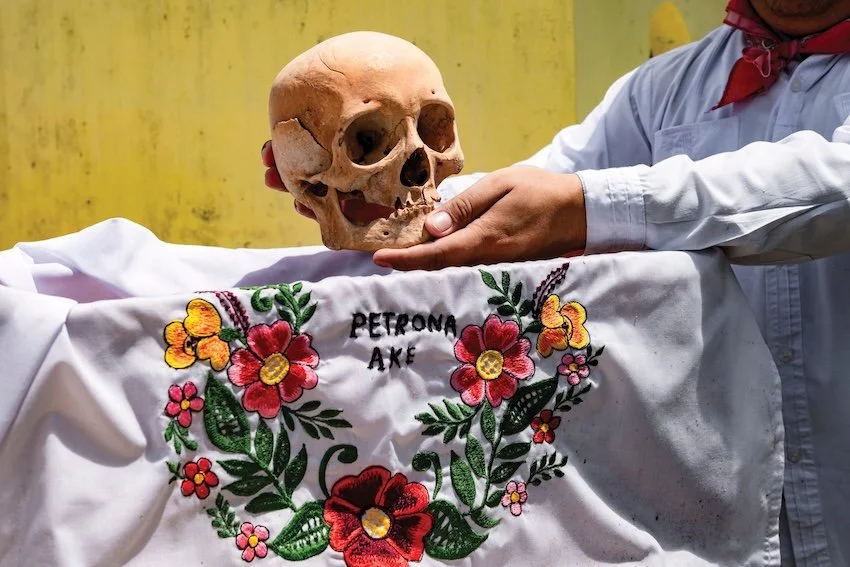
The souls visiting Pomuch, a town of just under 10,000 residents in the state of Campeche, are a little cleaner than those in the rest of Mexico. In 2017, the government of Campeche officially proclaimed “La Limpieza de los Santos Restos: Ritual Funerario de la Comunidad Maya de Pomuch” as Intangible Cultural Heritage. If your Spanish is up to par, you might think you’re reading that wrong.
You’re not. In Pomuch, it’s both legal and a longstanding tradition to exhume the skeletons of your loved ones, clean the bones, and display them in a pretty box that stays at the cemetery year-round.
Morbid? Thoughtful? Macabre? Tender?
Maybe a little bit of everything, which is what makes the practice so memorable.