
A broken kayak, a lost morning and the Island of the Dolls
Charlotte Smith is a storyteller and unapologetic observer of life in Mexico, who writes about the country as she experiences it - with curiosity, a healthy dose of skepticism, and genuine affection. From people and places to the strange, funny, and sometimes complicated moments of everyday life, Charlotte believes there’s a story almost everywhere if you stop long enough to notice it.
The plan wasn’t to end up on the Island of the Dolls.
The plan had involved a lovely and informative sunrise kayaking excursion with an English-speaking tour guide, a working farm, planting a seed, learning about the ancient agricultural methods still used in Xochimilco, and watching that promised sunrise over the canals.
We’d dragged ourselves out of bed at 2:45 a.m. for a 3:30 cab to Xochimilco, in the south of Mexico City. Xochimilco is famous for its canals and chinampas, the extraordinary agricultural islands developed centuries ago and is part of the UNESCO World Heritage site that recognizes the historic and cultural importance of the area.
Except nobody from our tour was there. After about 45 minutes of standing in the cold and the dark wondering what the hell we were meant to now do, another group took pity on us and invited us along.
It wasn’t our tour. It wasn’t in English. It didn’t include the farm, the seed planting, or most of the things we’d booked. But it did include a broken kayak. And without that, I’d have had no story. Funny how things turn out, isn’t it?
About ten minutes into the kayaking, our boat sprang a leak. Not a little leak, either. I’m talking a proper “gonna need a bigger boat” sort of leak. Water was coming in and we were soaked. The nearest place to repair it happened to be dock at the Island of the Dolls, or Isla de las Muñecas, which hadn’t been on either itinerary. So, wet arses and all, that’s where we went.
And there THEY were.
Dolls. Everywhere.
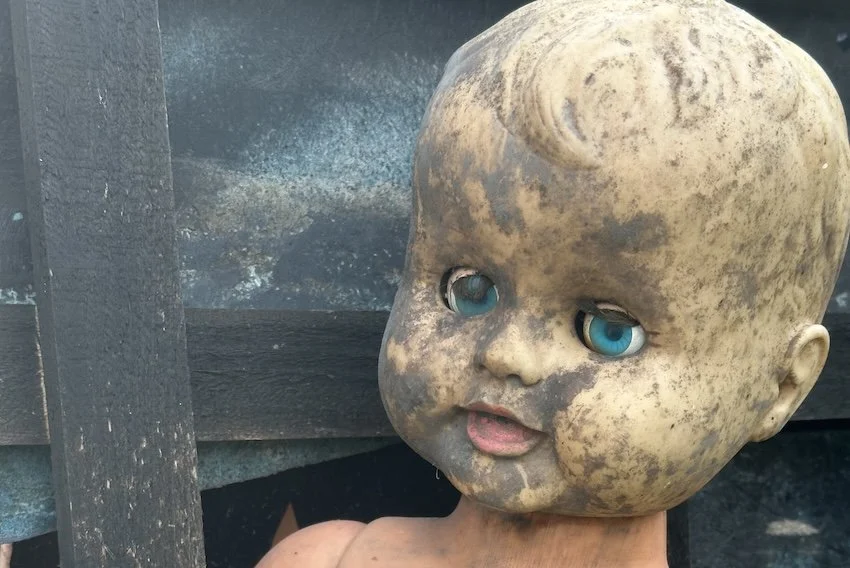
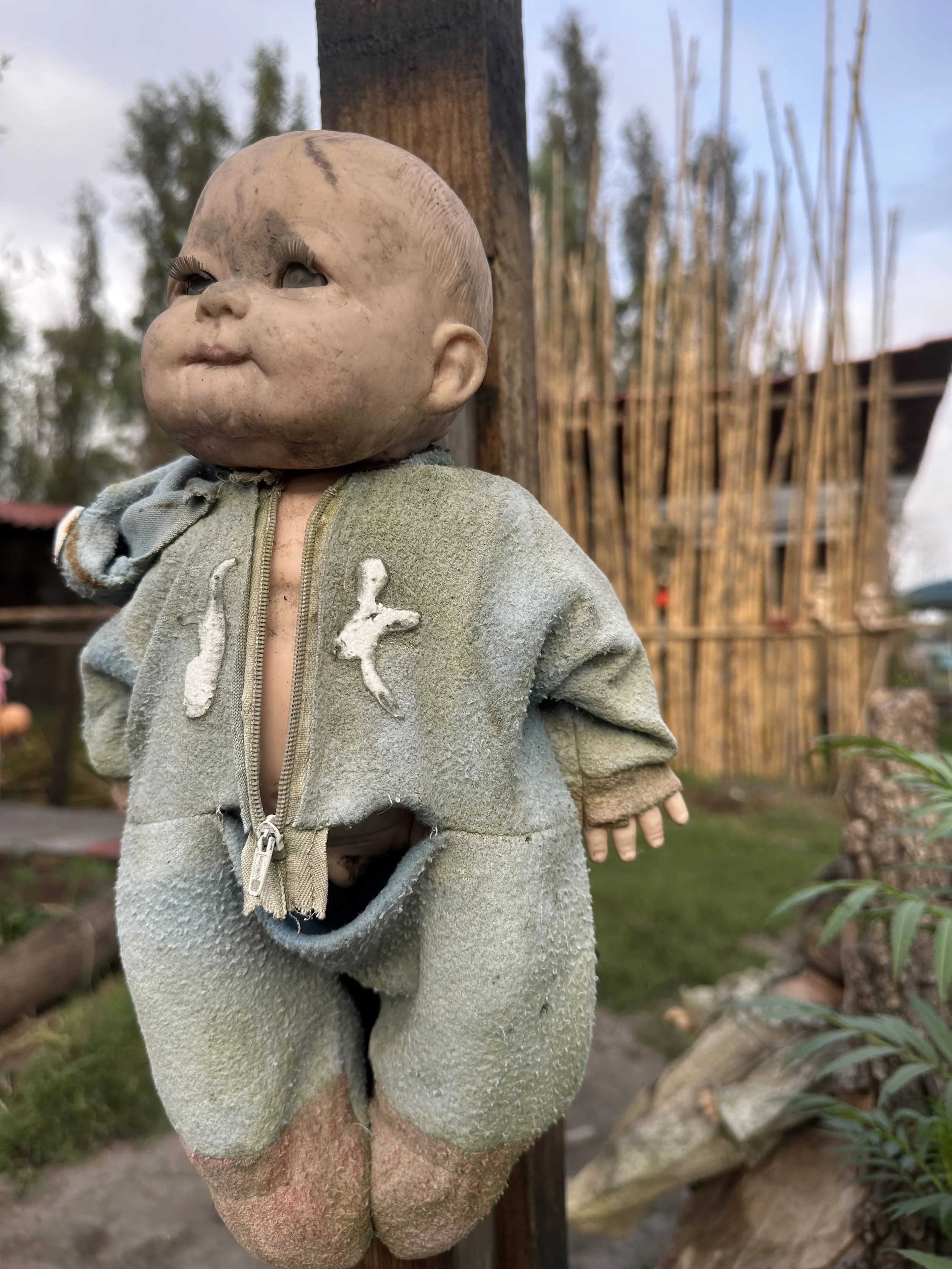
The first thing you notice is that these dolls have seen quite considerably better days. They’re hanging from branches, tucked into the greenery, propped against tree trunks, and suspended from (or nailed to) bits of wood. Their clothes are torn and filthy. What’s left of their hair is matted. Their little faces have been stained and weathered by years of exposure to the elements.
Some are missing limbs. Some are missing eyes. Some have heads that seem to have landed at angles no neck was ever designed to achieve. One had strings of hair hanging over its face so completely that you could barely see the features underneath. Another had one bright blue eye staring out while the other was dark and empty. All had little faces and tiny hands. Little bodies that still looked unmistakably like children’s toys despite the dirt, the damage, and the years of weathering.
They aren’t arranged neatly behind glass, because there’s no polished museum display. They’re simply there, scattered throughout the island as though the trees themselves have slowly collected them.
It’s creepy as hell. There’s no getting around that. But the longer I looked, the less frightening they seemed and the more sad they became. Because these aren’t horror props that were made to look abandoned. They actually are abandoned, and somehow, that felt more unsettling.
The story of the island begins with Julián Santana Barrera, a local man who lived on the chinampa for decades. Accounts describe him as a solitary figure who lived apart from much of the surrounding community and spent years collecting discarded dolls and hanging them around his home. The reason is where history and legend become tangled.
According to the story Santana told, he encountered the body of a young girl who had drowned in the canals. A doll was subsequently found in the water, and Santana hung it from a tree in her memory. From there, the collection grew. He continued gathering discarded or lost dolls over many years, and visitors eventually began bringing them too. So, the island slowly became what it is today: a landscape of weathered children’s toys suspended from trees and scattered among the vegetation.
The story of the drowned girl has become central to the island’s mythology, but there’s no independently established record that confirms all of the details. Some accounts also attribute supernatural experiences to Santana, including hearing voices or feeling the girl’s presence.
Those stories are part of the folklore of the island, but what isn’t in dispute, though, is that Santana spent decades creating this strange collection. He died in 2001, and the dolls remained. Standing there among them, I kept thinking about how different this place must have looked to the man who created it.
We arrived as visitors who took photographs of creepy dolls. We made jokes about whether one of them was going to move when we weren’t looking. I now write a story and tell people about a bizarre place in the canals of Mexico City.
But for Santana, this wasn’t a tourist attraction. This island was his home, and that changed things for me. The longer I looked at the dolls, the less interested I became in whether they were haunted. What struck me instead was how neglected they looked. Yet, beneath all that weathering, many were still unmistakably dolls with little faces that had once been clean.
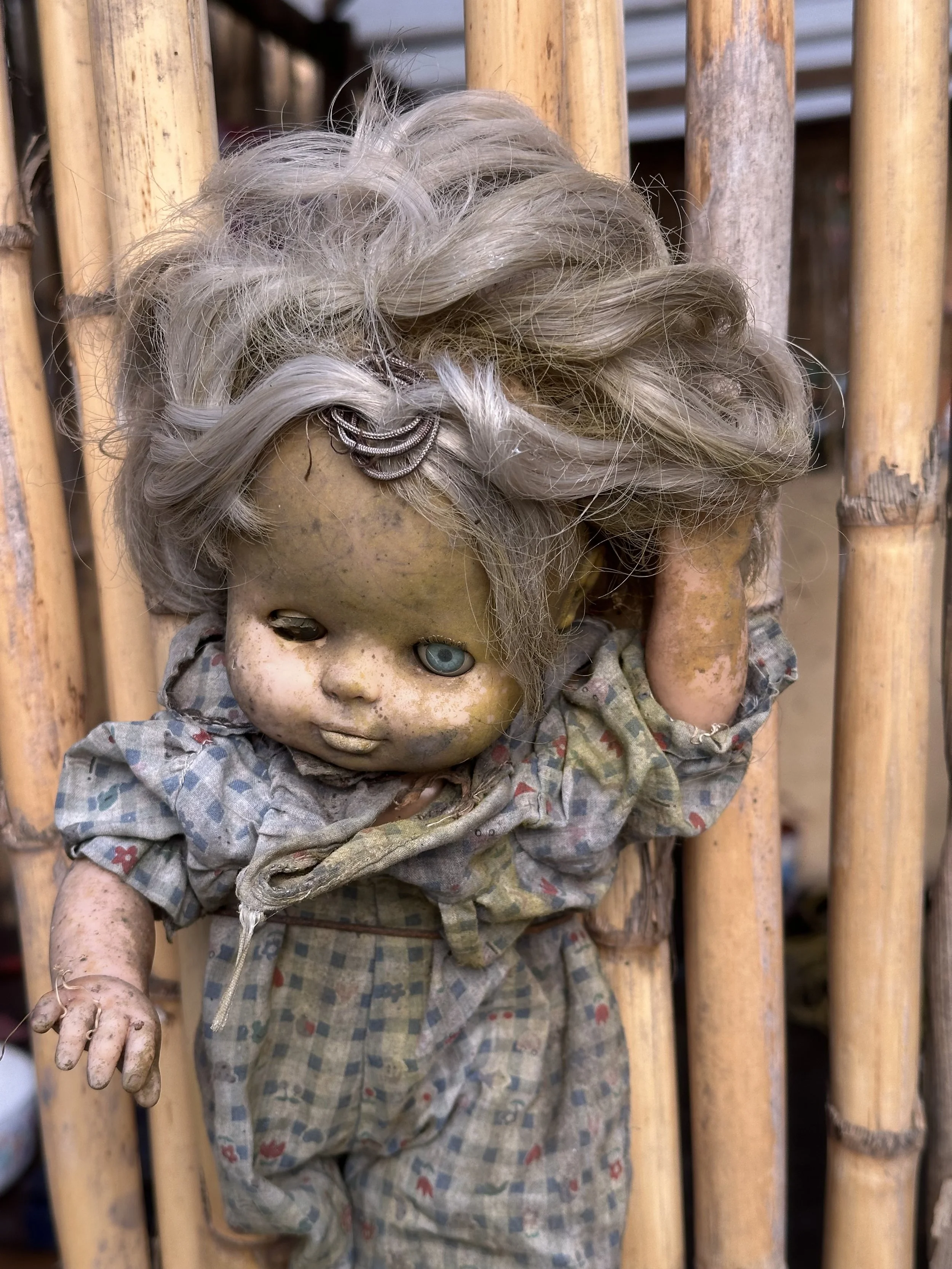
I imagined them in their little outfits that had once been new. I saw them as toys that somebody, somewhere, had once chosen, bought, and loved. Now they hung from trees, slowly falling apart. I found myself thinking about Julián Santana Barrera. We can’t know what he felt, what he believed, why he amassed this collection, or what each doll meant to him. And we shouldn’t pretend that we can.
Accounts of his life describe a man who lived a lonely existence, and I couldn’t help wondering whether he saw something in those dolls that the rest of us didn’t. Perhaps they offered comfort. Perhaps they gave him a sense of purpose. Perhaps they gave him company. Or perhaps, in some small way, he recognized something of himself in them.
Something cast aside or misunderstood. Something left on the margins. Something that had once been wanted and was now forgotten.
Maybe the dolls made the island feel a little less empty. It’s only a thought, of course. I never met the man, and I can’t claim to know what was happening inside his head. But standing among those hundreds of neglected little figures, it was difficult not to wonder whether the place he’d created was out of a need for something comforting.
And that possibility has stayed with me.
Our kayak eventually got repaired, allowing us to continue through the canals. And as we left that place that looked like it should have been the thing we needed rescuing from, I found myself smiling at how it, quite literally, was where we were saved. Maybe that’s part of why I’ve thought about it so much since.
The story of Julián and the drowned girl is impossible to separate completely from the mythology that grew around the island. We don’t know exactly what happened to her or what he believed he was doing when he began hanging those dolls from the trees. But I keep thinking about the idea of a lonely place becoming a place of refuge.
We’d arrived there by accident, cold and soaked, with a broken boat and absolutely no idea what the morning was going to become. And somehow, the island was where we stopped, got help, and carried on.
Perhaps that’s just me stretching the metaphor too far, but I rather like the thought that a place created, at least in part, because one man couldn’t bear the idea of a little girl being left alone in the water might, all these years later, have helped two very wet tourists find their way onward too.
Maybe that’s why I don’t quite see the island as frightening anymore. Maybe it’s a place where lost things are given somewhere to be.
We never saw the sunrise we’d booked because, as it turned out, our replacement tour started an hour and a half later than the one we’d originally booked. But we did see a part of Xochimilco we hadn’t expected to see. We were welcomed onto a tour that wasn’t ours by people who didn’t know us. We ended up having breakfast at the home of the people running that tour, and I discovered that my Spanish held up far better than I’d feared. We survived being absolutely soaked. We survived each other’s terrible moods. And we ended up on an island covered in old dolls.
It wasn’t the morning we’d ordered. But somewhere between the broken kayak, the language barrier, and the cold and the wet clothes, we eventually stopped fighting the day and started laughing at it.
Because sometimes you just have to.
I don’t believe the dolls are haunted, and honestly, the island isn’t even one of the strangest sights I’ve seen in Mexico City. But I will remember the island for the rest of my life. Somewhere between the creepy faces, the tangled hair, the weathered rags, and the broken little bodies, I stopped seeing a collection of haunted dolls, and I started seeing things that looked lonely. I started thinking about the man who had spent so many years collecting them.
Perhaps Santana saw something of himself in them. Perhaps he simply didn’t want to be alone. We’ll never really know. But there’s something unexpectedly human about creating a world of your own and filling it with things that make you feel less isolated.
The Island of the Dolls is strange and unsettling. But beneath all of that, I found something I wasn’t expecting to find in a place I’d never even intended to visit. A little sadness. A little tenderness. And the reminder that loneliness doesn’t always look the way we expect it to. And neither does the search for comfort.
Sometimes, the places we stumble upon by accident turn out to be the ones we remember longest. Maybe they even help us find our way forward. This was, most certainly, one of those places.