
Chris Havler-Barrett is the editor of Mexico Featured.
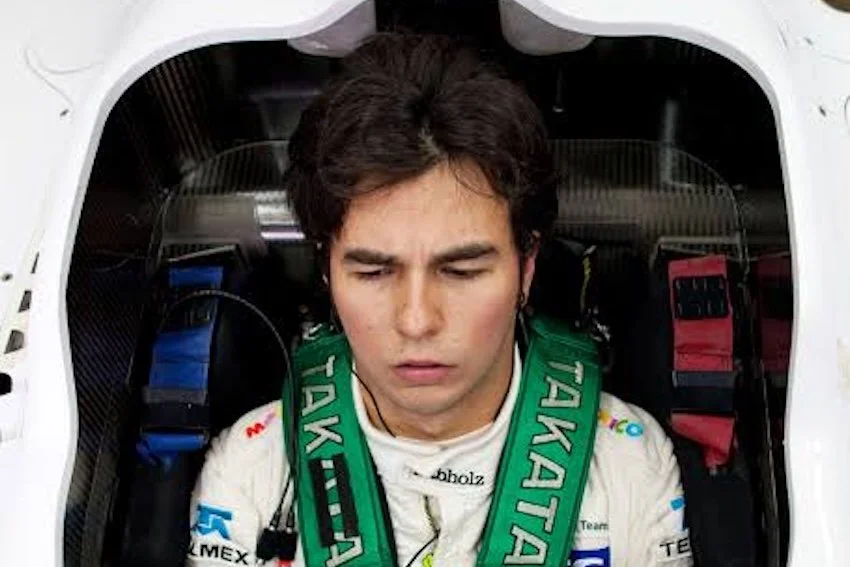
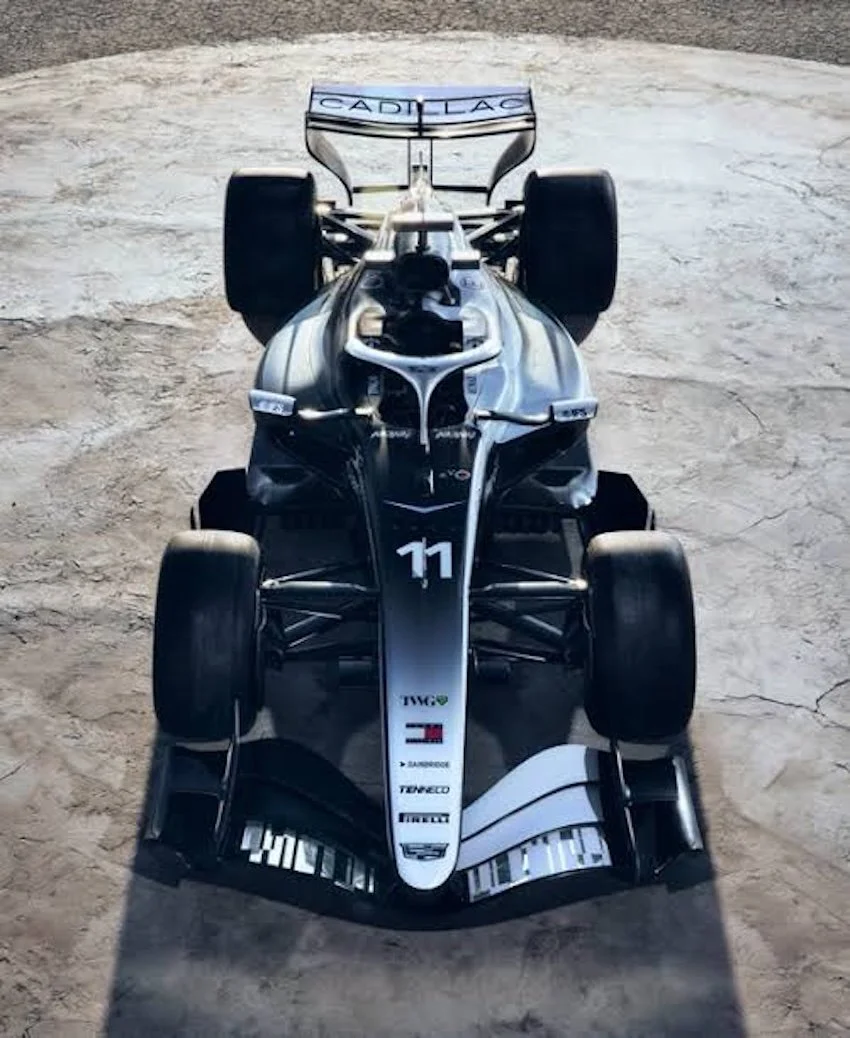
On Wednesday morning, Paseo de la Reforma will close to traffic so that Sergio “Checo” Pérez can do what most chilangos only dream of doing on it: put his foot down. From 10 a.m., the Guadalajara-born driver will take a Cadillac Formula 1 car down the stretch between the Diana Cazadora statue and the Ángel de la Independencia, in front of a crowd organizers expect to top 120,000.
The show run marks a milestone. On Sunday, at the Autódromo Hermanos Rodríguez, Checo will start his 300th Grand Prix. Wednesday will be a loud, joyful and faintly absurd morning (doughnuts on Reforma are always faintly absurd), and the crowd will be wild for every second of it.
But a show run can only show so much. Anyone can look quick on an empty boulevard. What made Checo one of the most respected racers of his generation only reveals itself over the length of a full race: how long he can make a set of tires last, how he picks his way through traffic, and how often he crosses the line higher than he started.
In everyday English, a “Sunday driver” is someone crawling along in the fast lane, out for a leisurely ride on the weekend. In Formula 1, it’s a compliment — the driver who looks ordinary in Saturday qualifying and is suddenly everywhere by Sunday evening. For 15 years, Checo has been the sport’s definitive Sunday driver. It’s also the part of his game that F1 has been slowest to appreciate.
To understand why, you have to understand tires. Modern F1 tires are built to wear out — Pirelli designs them that way on purpose, to force pit stops and shake up the running order. A driver who pushes too hard burns through a set in a handful of laps and spends the rest of the stint sliding around. A driver who is gentle with them can run longer, stop less, and still have grip at the end of a race when everyone else has run out.
Checo has always been the second kind. For a decade in the midfield, engineers built entire race strategies around his ability to make a set last longer than anyone else’s, often running one pit stop fewer than the cars around him.
The finest example came at the Sakhir Grand Prix in Bahrain in December 2020. Checo was already a man without a job: Racing Point had announced months earlier that it was replacing him with four-time world champion Sebastian Vettel. On the first lap, Charles Leclerc’s Ferrari tagged him at turn four, spinning him around and dropping him to the back of the field.
What followed was a masterclass. Checo carved his way back through the pack, nursing his tires while the cars around him chewed through theirs. When Mercedes botched a pit stop — fitting George Russell’s car with tires meant for his teammate — the race fell apart for the leaders, and Checo swept into the lead. It was his first win, at the 190th attempt, and the first by a Mexican driver since Pedro Rodríguez in 1970. “Ten years, 10 years it took me,” he said afterwards.
The closest parallel in recent memory is Jenson Button, the British 2009 world champion, at the 2011 Canadian Grand Prix. That afternoon in Montreal, Button collided with two cars (one of them his own teammate, Lewis Hamilton), served a drive-through penalty, made six pit stops and at one point ran dead last. He won by passing Vettel on the final lap.
Button and Checo are cut from the same cloth: smooth, gentle on their equipment, and blessed with a sixth sense for when a race was about to turn. Both came alive in changeable conditions that punish brute force. And both shared the same weakness — when a car stopped giving them the feel they needed, they lost more speed than their more aggressive rivals did. That would come back to haunt Checo at Red Bull.
Five of Checo’s six wins came on street circuits: Baku (twice), Monaco, Singapore and Jeddah. These are tracks lined with concrete walls instead of gravel traps, where a driver who overreaches ends his race in the barriers and a driver who hesitates gets swallowed up. They reward precision under pressure over raw one-lap speed — exactly Checo’s skill set.
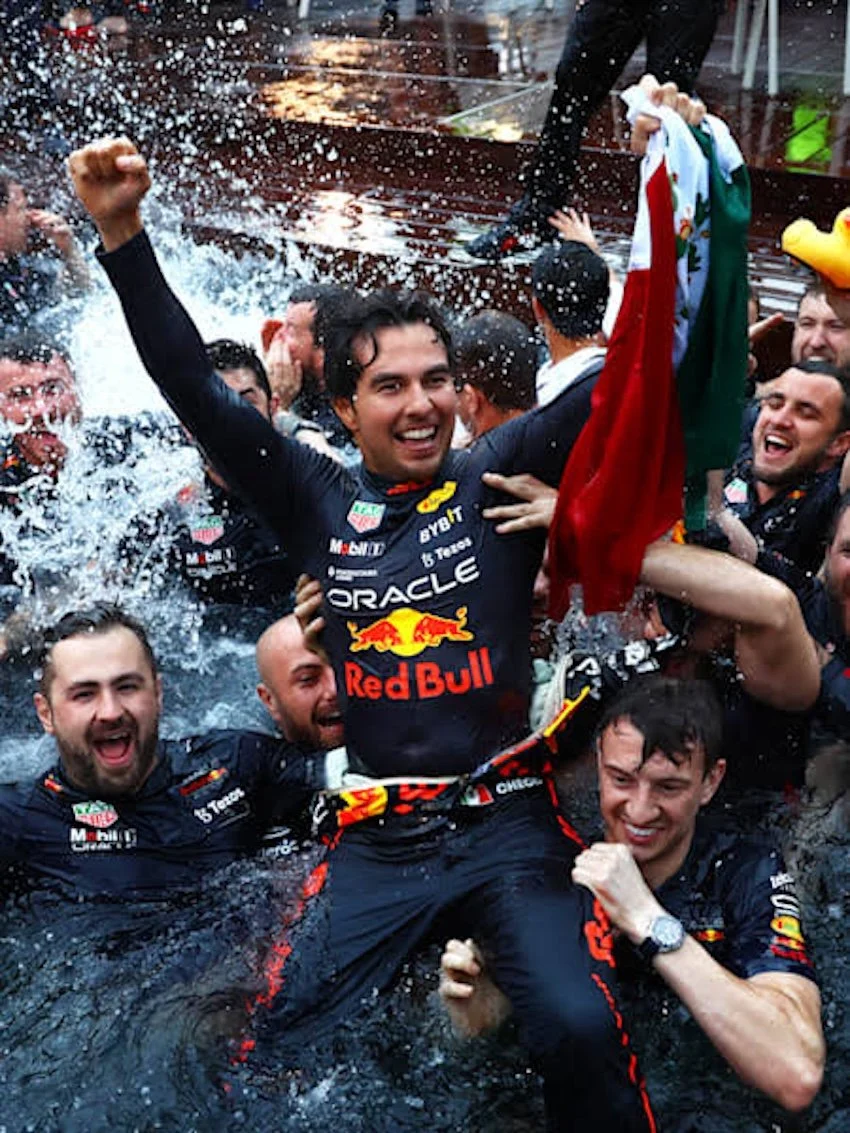
His 2022 win in Monaco, run in rain-soaked, chaotic conditions, showed it perfectly. Wearing a helmet painted in tribute to his idol, Pedro Rodríguez, Checo jumped from third to first through the pit stops as the track dried, then spent the rest of the afternoon with Carlos Sainz’s Ferrari glued to his gearbox, never giving him a sniff. The win that day propelled him past Rodriguez, to become Mexico’s most successful F1 driver of all time. That October in Singapore, he beat Leclerc away from a wet start and kept him at bay for two hours.
He was also very, very hard to pass. At the 2021 Turkish Grand Prix, he went wheel to wheel with seven-time world champion Lewis Hamilton through several corners on a damp track, and kept his place. A few weeks later in Abu Dhabi, with the championship on the line, Checo held Hamilton up for the best part of a lap, letting teammate Max Verstappen close a gap that had looked unbridgeable. Verstappen won the race and the title, and called Checo “a legend” over the team radio.
Checo isn’t the first Mexican to make his name this way. Pedro Rodríguez — Mexico’s first F1 race winner, and one of the two brothers the Autódromo is named after — did his best work when the conditions narrowed the gap between machines. He won two Grands Prix, in South Africa in 1967 and Belgium in 1970, in cars few expected to win anything. But his real reputation was made in sportscars, where he was among the finest wet-weather drivers of his generation. He won Le Mans in 1968, after retiring from nine of his first ten attempts, and at Brands Hatch in 1970 he won the 1,000-kilometer race in torrential rain by five clear laps.
That fearlessness cuts both ways. At his home race in 2023, starting fifth, Checo tried to go around the outside of Verstappen and Leclerc into the first corner, tangled with the Ferrari, and was out before the end of the opening lap. It was the same instinct that won him Monaco. It just misfired at the worst possible moment, in front of the people who most wanted to see it work.
Every driver has a weakness, and Checo’s has always been qualifying. A single flying lap on fresh tires rewards a driver who can wring everything out of a car instantly, with no time to settle in — and that was never Checo. In the midfield it cost him a few grid places, which he would usually claw back on Sunday. At Red Bull, alongside Verstappen, it came to define him.
The Red Bull of those years was developed around Verstappen’s driving style: a car with a razor-sharp front end that the Dutchman could balance on the edge of a spin, and that most other drivers found impossible to trust. Checo, whose speed depends on feeling what the rear of the car is doing, was quick when it was stable and lost when it wasn’t. In 2023 he won two of the first four races and finished runner-up in the championship — the best season any of Verstappen’s teammates has managed. Yet that same summer he failed to make the final round of qualifying in five straight races. A driver who starts 12th spends his afternoon stuck in traffic, burning through the tires he would normally save for the finish — no matter how good their racecraft might be. His greatest strength was being spent covering for his weakness.
The relationship had already curdled by then. At the 2022 Brazilian Grand Prix, with second place in the championship at stake for Checo, Verstappen ignored a team order to let him through on the final lap. Checo ended the year three points behind Leclerc. In 2024, after a strong start, he went most of the season without a podium, Red Bull lost the constructors’ title, and in December he was out.
He wasn’t the only one to struggle in that seat. Pierre Gasly and Alex Albon had both been demoted from it before Checo arrived, and the two drivers who replaced him in 2025 fared no better — Liam Lawson was sent back to Red Bull’s junior team after just two races. None of that excuses 2024. But it does suggest the car was built for one very particular way of driving, and only one man at Red Bull drove that way.
Mexico had seen this before. In 1981, Héctor Rebaque — who had once run his own F1 team out of a warehouse in Leamington Spa, England — landed a seat at Brabham, one of the top teams of the era. He finished a distant 10th in the standings. His teammate, Nelson Piquet (coincidentally now Verstappen’s father-in-law), won the world title in the same car.
Cadillac came calling after Checo had spent a year on the sidelines, signing him and Valtteri Bottas — two Grand Prix winners with more than 500 starts between them — for its debut season. Nobody expected a brand-new team to be quick straight away. Even so, 2026 has been tough going. Cadillac is the only team yet to score a point, Checo’s best finish is 14th, and he has retired from five races. Last week, he told Televisa that the project needs more time than he had thought — and that he won’t be racing for much longer.
When the car is this far off the pace, the only fair yardstick is your teammate, and by that measure Checo has done well. Bottas is a 10-time Grand Prix winner who spent five years alongside Hamilton, probably the greatest of all time, at Mercedes. Through the first 14 races of the season, Checo out-qualified him eight times to six, and in the five races they both finished, Checo came out ahead in four. One statistician who tracks lap times in clean air measured him as more than half a percent faster on race pace — a big gap between teammates in the same car. Close on Saturdays, clear on Sundays. Some things never change.
The Mexican Grand Prix has drawn some of the biggest crowds on the F1 calendar since it returned in 2015, and Checo is a large part of the reason. He came back when he didn’t need to, to a team that was always going to start near the back, and he has kept showing up for it — and for Mexico.
Most of the people on Reforma on Wednesday will remember the doughnuts. But on Sunday, from somewhere near the back of the grid at the track named for Pedro and Ricardo, the brothers who wrote Mexico’s first chapter in F1, Checo will line up for the 300th time. Watch where he finishes.
Where to watch Checo’s showrun (if you’re not in Mexico City)
You can watch all the action (and the adoring crowds) on Desde El Paddock