
In the news: The patron saint of fuel thieves
Bethany Platanella is a travel planner and Michelin Guidebook writer based in Mexico City. She lives for the dopamine hit that comes directly after booking a plane ticket, exploring local markets, practicing yoga and munching on fresh tortillas. Sign up to receive her Sunday Love Letters to your inbox, peruse her blog, or follow her on Instagram.
Each week, Mexico Featured now zooms in on a single news story that could only come out of Mexico, whether it’s a centuries-old tradition colliding with modern life, a regional quirk that made national headlines, or a moment that captures something essential about the country’s character. Think of it as a small window into the culture, humor, and complexity of daily life in Mexico.
Iván Cazarín Molina, aka “El Tanque" was arrested on Tuesday this week, in Zapopan, Jalisco, pulling us back into a multi-billion-dollar underworld fueled by folk saints, front gas stations, and ‘Robin Hood’ kickbacks.
Sometime in 2016, he appeared.
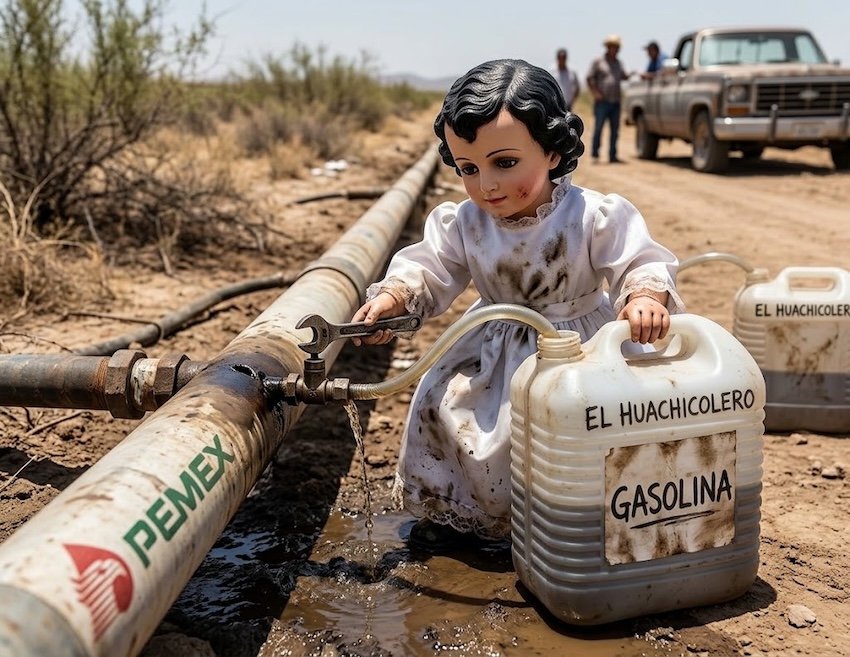
Not as an apparition, per se, but as an icon, a thread that bonded families whose only income sprouted from the depths of Mexico’s underworld — El Santo Niño Huachicolero, the protector of fuel tappers. Identical in look to Santo Niño de Atocha, the Patron Saint of those unjustly imprisoned and travelers, instead of a pilgrim's staff, Santo Niño Huachicolero holds a mini jerrycan and a coiled hose.
After all, someone has to protect those entrenched in the extremely dangerous fuel siphoning trade.
Stolen gasoline is mixed with ethanol or, in some cases, water, and resold to local farmers and taxi drivers at 40%–50% below market value. To the Mexican fuel market, it bleeds billions. To engines, it corrodes. But it’s the way huachicol affects, or, one might even argue, benefits, those that reside in the rural pipeline corridors of Puebla, Hidalgo, Jalisco, Guanajuato and Michoacán, that has enabled El Tanque to turn small-town theft into one of CJNG’s most lucrative income streams.

Stealing fuel is a highly dangerous practice that involves several steps.
First, the huachicolero has to weld the valve to avoid explosion, using a power generator and portable welding equipment to fuse a mechanical valve directly onto the outer metal wall of the active pipe.
Next, a specialized manual or mechanical drill is inserted through the open valve directly through the pipe's wall. If the fuel begins to escape, the drill must be backed out immediately and the valve quickly closed.
Finally, industrial-grade hoses are attached to the newly installed valve. The hoses are often buried underground to avoid military drones or security patrols.
Of course, this all requires money, which CJNG has plenty of, and which Molina has allegedly managed since 2013.
Under his watchful eye, specialized engineers are hired to build highly sophisticated tunnels, which come fully equipped with ventilation and lighting, that connect Pemex pipelines to cartel-owned properties (i.e. rural ranches or urban industrial warehouses). Here, on-site commercial tanker trucks receive millions of gallons of stolen fuel that can then be distributed throughout the country.
In 2025, Pemex reportedly lost $23.4 billion pesos (roughly $1.2 billion USD). CJNG’s profits are incalculable, likely somewhere in the hundreds of millions, and some of this profit is redistributed into the communities in which the cartel operates. It’s something known as narco-philanthropy – we might call it the Robin Hood effect.
On Three Kings’ Day in 2026 (Mexico’s equivalent to Christmas Day), masked men in tactical gear - and some very telling “branding” - were seen handing out toys in marginalized communities in Michoacán. Or on Mother’s Day in 2021, when similarly dressed “neighbors” distributed household appliances and food across Guanajuato, Jalisco and Michoacán. They’re also credited with road repair and funding health clinics, building sports complexes and plain old cash stipends.
But where Santo Niño Huachicolero was hiding on Tuesday, October 6, when a joint operation between Mexico's National Intelligence Center (CNI) and the U.S. The Drug Enforcement Administration (DEA) resulted in Molina’s arrest, we’ll likely never know. What we do know is, the tappers will keep on tapping, with or without El Tanque.